
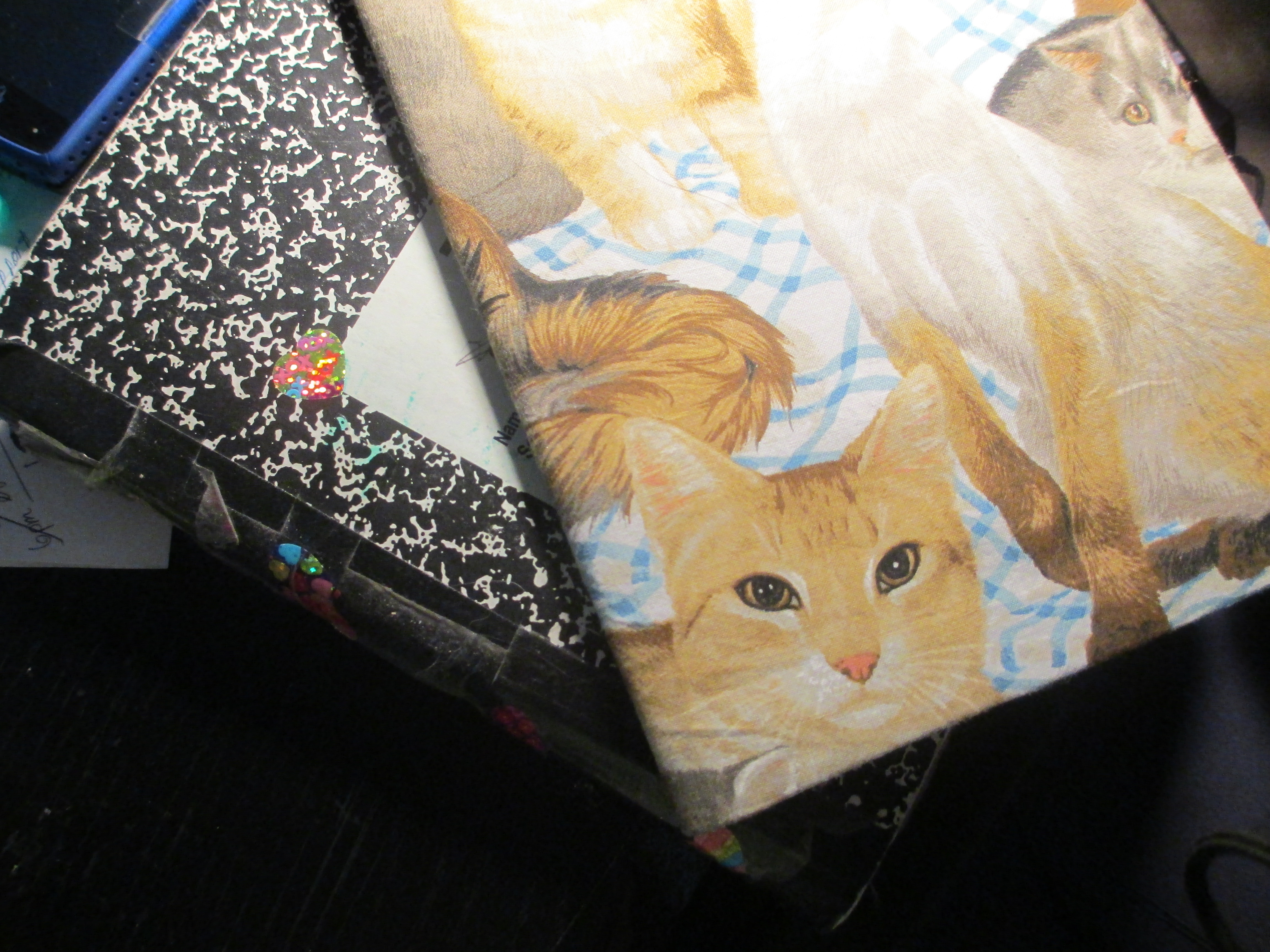
Beginning writers write by doing copywork. My students enjoyed copywork in the early elementary years. Each got to pick a lined composition bound notebook from the office supply store. Each got to choose a piece of fabric to cover the book with, and each got to choose favorite passages and poems to copy. After copying, they got to draw pictures and color around the copywork, and it was the beauty of the process, the art product, that made copywork something special that my students looked forward to.
Technically, copywork begins when students trace letters. From there, students may gradually move to copying from a card or paper set directly in front of them. It helps if there is only one line on the card, or if the student’s paper can be positioned to move down line by line. This reduces the distance the student’s eyes have to travel between model and copy. Eventually you can move to copying from the board, or from a book. For convenience, buy a little wire stand from an office supply store to keep books open. When the student is comfortable with simple copy work, begin some easy dictation. For any given piece of writing, you can do a bit of both. For example, start with the dictation of a single sentence, then allow the student to copy the rest. Gradually increase the proportion being dictated. You can also adjust the challenge of dictation by increasing your speed and decreasing the number of repetitions you give.
From Less to More
A younger student will start out by copying letters and single words. Work from there into copying single sentences, multiple sentences, and then whole models of several sentences to several paragraphs. When you shift your student from coptwork to dictation, start with just a few words or a single sentence and increase the amount of material gradually.
From Studied to Unstudied
Studying a piece of writingl before copying or dictation – especially before dictation – can also help a student to reproduce it more efficiently. Point out, and if necessary mark with a red pen, all punctuation, capitalization, and potential spelling problems. For copying, you can also mark off sentences or phrases or clauses to encourage the student to work several words at a time. For dictation, note the larger patterns of phrases, clauses, and sentences. When you dictate, always read the entire sentence first and encourage the student to just sit and listen and not begin to write. After reading the entire sentence so that the student is able to absorb the complete thought, then dictate whole phrases or clauses.
From your example (as described above), the student can learn to study the model first on his own before you dictate. Eventually, eliminate the need to study the model first. Your ultimate goal is for the student to take dictation from an unstudied model.
From Hints Given to No Hints Given
For dictation, you can also give hints as you go. The most help you need to give will be to proactively point out capitalization, punctuation, and spelling as you dictate. Tell the student exactly what he needs to know each step of the way. Write all words difficult to spell on the board. This is a gentle way to begin dictation. From there, gradually decrease the number of helps given, but respond to all your student’s requests for clarification. Ultimately, your goal is for students to take dictation without any help or hints.
From Easier to Harder Material
Last, increase the challenge by offering harder material. More difficult words and more complex sentences will require students to think very carefully as they write. Do not hesitate to return to copywork with difficult material before you try dictation on it.
Copywork and dictation are skills that are built up over many years. It will probably not be until grade 4 or 5 that students will be very comfortable with dictation on any but the simplest material. Whenever frustration sets in, return to copying for a while.